News flash! Lots of people are buying and selling gold these days. The reasons seem simple enough. News flash! Lots of people are buying and selling gold these days. The reasons seem simple enough.
From the public's perspective, "it's the economy, stupid".
Why not ditch those trinkets that've been gathering dust in Mama's jewelry box and walk away with some ready lucre?
From the trader's POV, gold is now selling at record levels so it's high time to rustle some more up from "them thar hills".
But, what about diamonds? Aren't they also a highly prized and non-renewable resource, a hard asset, and an increasingly valuable collectible?
What if you don't need your ice anymore? What if you'd just rather cool your heels with some cold cash?
Well, selling your diamond is certainly not as easy as selling mere gold. That's because anyone with a scale, a test kit, and a checkbook can flip gold. It takes a lot more savvy to properly assess diamonds - let alone buy and sell them.
Here's some advice if you find yourself ready to let go of your bling. IMHO most pawnshops and websites lack the proper expertise. That typically translates to the least amount of loot for you.
It's safer, easier, and much more practical to use the professional services of your favorite jeweler. Mind you, there will usually be several options to consider.
They may offer to consign your diamond and sell it for you. They will retain a percentage for making the sale and you will receive the balance. This can take time.
They may also offer in-store credit toward a trade-up or other new merchandise. This is normally for a larger dollar amount.
Last and most likely least, they may flat out offer you immediate cash at a substantially lower rate.
Your final choice will be limited by your flexibility on price as well as your time constraint.
I definitely do not recommend trying to sell directly to John Q. Public, for example through classified ads. There are extremely cogent reasons for jewelers to have top-flight security systems and insurance policies.
 This is one of the coolest pictures I've found of a diamond's crystal lattice. Maybe its not that accurate, but it sure is pretty and I thought it might grab your attention. This is one of the coolest pictures I've found of a diamond's crystal lattice. Maybe its not that accurate, but it sure is pretty and I thought it might grab your attention.
It's tiring to always be focused on finished gems. So, let's look at some other diamond curiosities.
You probably already know something about how diamonds are formed. As the story goes, they are formed deep under the crust of the Earth where atoms of carbon grow upon one another in a molten slurry under intense heat and pressure.
They are then blasted to the surface in volcanic pipes. It is convenient that these super-hard crystals arrive in super-soft kimberlite. Diamond mines may be remote, but once found processing the ore is a relative cinch. Even rain and rivers can wash diamonds free.
But, wait there's more. Believe it or not some diamonds come from outer space. In fact, a recent story about "shock synthesized hexagonal nanodiamonds" from a meteorite strike in California grabbed my attention. Thankfully the hit was over 12,900 years ago!
These little guys offer the hypothetical cause for a massive die-off on a continental level of such megafauna as the Channel Island pygmy mammoths. Wow! To think I never even knew they were here first.
And then there are nanodiamonds from inner space, too. I'm talking about tiny micro diamonds that are synthesized in laboratories. Usually polycrystalline - they're not like the single crystal in our picture. They are made in films, i.e. thin coatings not the cinema.
Scientists are having a field day dreaming up uses for these teeny suckers. At Melbourne University they're thinking that carbon-based nanodiamonds may lead to the actual development of quantum computers, using qubits rather than plain old-fashioned bits to store data. Why am I thinking diamond covered q-tips?
Oh yeah, there are also nanodiamond tips. Apparently atomic force microscopes use dip-pen lithography to print advanced circuitry and DNA sequencing. If that don't just beat all, those pens can break down quickly. But not if they are coated in nanodiamonds.
Will miracles never cease? Maybe not. Just today, yet again comes an article - with some precocious comments too - teasing us with the discovery of something even harder than diamonds.
And, I thought that reward already went to Calculus. The theory is that some kind of boron molecule can do the trick. It all sounds confusing and sketchy to me.
I say, "Bring it on". Us diamond cutters could use a break, and some diversion too. Or so it would seem.
 If you can't bring the best round diamonds to market, why not make them different - by simply adding more facets for example? If you can't bring the best round diamonds to market, why not make them different - by simply adding more facets for example?
Because, as a rule they don't deliver any extra brilliance.
Can we say "dead as a doorknob"?
Maybe not, but let's make no mistake about it - the 58 facet modern round brilliant has a very long and impressive pedigree of development. And, it's not merely some shaggy dog story!
In fact, the most current research shows that extra facets generally create less facet contrast. This shows up as less sharply defined brightness, fire and sparkle! And, these are supposed to be the classic elements that define diamond beauty.
Although many variations and permutations have been explored over the past several centuries, the modern round is the paramount style of cutting. So much so that it's the basis of most other shapes as well; including ovals, pears, marquises and heart shapes.
The reason is simple. It works!
The look of the classic round is extremely desirable and appealing. That's why over 80% of all diamonds sold are cut in this style. That's why it's still the best way to say I love you. That's why it commands and holds the highest value.
Does that mean other styles are no good. Of course not! Tastes differ. There are always those who seek new alternatives.
As luck would have it, computer models have recently made it much easier to experiment with new styles. Cutters need no longer travel blind, running the risk of totally trashing extremely precious raw material. This is a very good thing!
But, it's also new territory. The jury is still out. It's far too soon to know for sure which styles will die on the vine of marketing hype, or get real legs and true staying power in terms of both beauty and value.
 In trying to have the last word on the importance of the Cut in defining a diamond's appeal, many sellers promote magic numbers - like "100%" light return. In trying to have the last word on the importance of the Cut in defining a diamond's appeal, many sellers promote magic numbers - like "100%" light return.
Buyers beware!
That notion is far too simplistic. I find that "light return" percentages are rather meaningless for many reasons. A mirror returns 100% of the light shined on it. Is it as beautiful as a diamond? Nope!
There are various methods used to measure so-called light return. Mostly it is done by “virtual modeling” of the diamond. These models are defined by exterior measurements of a stone which are then used to create a computer model, which in turn is subjected to light ray-tracing analysis (AGS and GIA and DiamCalc).
Others simply use only “face-up” lighting, pixel-counting methods and/or undefined numeric scales (Brilliant Scope and Isee2). But we already know that "100% light return" is definitely not the Holy Grail of diamond beauty - even if it were possible to achieve.
Ironically, the pictures that are offered as "proof" of 100% light return are a case in point. You should ask yourself why there are various shades of red/pink and black/grey and even white in these types of photos (Fire Scope and Ideal Scope).
Don't they actually highlight different and/or varying degrees of "light intensity"? How drastically will they change when the diamond is tilted to one side or the other - as is the reality in everyday usage?
The look of a diamond changes dramatically whenever the position of the diamond, the light and/or the observer is changed. It should be easy to understand that viewing a diamond exactly perpendicular to its table is only a rarefied or "special" case. What do you suppose happens to the picture whenever you view a diamond from any other angle?
One thing everyone knows for sure, every gem diamond is a 3-Dimensional and dynamic work of art. No one can capture diamond beauty in a single photo. Any photo is a mere snapshot of the full-motion picture of potential diamond beauty.
Perfection has always been a moving target. To be sure, lots of research has been done during the 300+ year development of the modern round brilliant. Cutters have always striven to do their best. Gemologists and other scientists have resolved to understand the complex math and physics.
And, of course, consumers have always voted for their preferences with their pocketbooks.
Suffice it to say there is no international standard defining appropriate light return. But yes, in a well cut diamond the majority of high intensity light that enters the diamond should return back to the viewer.
A diamond designed to return even 100% of low level light wouldn't be very desirable.
In general, the major trade labs have recognized that “light return” is a misnomer and the use of it alone is misleading in analyzing the overall “light performance” of high quality diamonds.
It has been shown that a small amount of "leakage" is not only unavoidable: it actually creates positive contrast effects that are quite visually pleasing.
 The Hope The Hope
The Hope Diamond is one of the most famous diamonds in the world. Guess why? It’s big. It’s blue. It glows bright red under black lights. And, it has history. The Smithsonian Institute just announced that it is celebrating 50 years of owning the Hope. In honor of this milestone, they are sponsoring a contest to select a new design for the setting surrounding the Hope. Well, it’s not really a contest. The Harry Winston Company, namesake of the donor who bequeathed the Hope to the National Gem Collection, was commissioned to submit all three new designs.
The public has only been asked to choose which one they like best. My vote goes to re-cutting the Hope itself!!! Why? Because, it’s high time that this most precious of all gems be seen in its best light. You might think that sounds sacrilegious or perhaps I’m just joking. But, you’d be wrong. I’m serious!!! Like most well-known diamonds the Hope is famous for both fact and fiction. It is the biggest blue diamond around. But, its history is also replete with myth, guile and hype. The Truth... Mystery surrounds the very origins of the Hope. The earliest record of any blue diamond big enough to have produced the Hope was provided by Jean-Baptiste Tavernier - gem dealer, world traveler and raconteur extraordinaire.
His stone, supposedly plucked from a Hindu idol’s eye in India, became known as the “Tavernier Blue”. It weighed approx. 115 carats and was sold to King Louis XIV in 1668. The Sun King took full power of his throne upon the death of Cardinal Mazarin, whose name is widely associated with the first brilliant style diamond cuts.
The King had his royal jewelers re-cut his blue diamond for better brilliancy, yielding a shield shaped diamond weighing approx. 69 carats. His great grandson Louis XV later had the “French Blue” set prominently in his jewel the Order of the Golden Fleece. In late 1792, as Revolutionaries deposed the monarchy, the Royal Storehouse in Paris was ransacked by thieves and the French Blue disappeared forever. However, in 1812 just shortly after the 20 year statute of limitations expired, a large blue diamond was spotted in London. This stone later showed up in the collection of Henry Philip Hope and has been known as the Hope Diamond ever since.
Nobody knows exactly how and when he came to own it, but the Hope Diamond finally saw the light of day weighing a bit over 45 carats. After Henry Hope died, his treasured diamond passed among his family. It was eventually sold by Cartier to the Washington DC-based, hard-rock mining heiress and socialite Evalyn Walsh McLean.
Unlike Mr. Hope who kept his gem collection private and under wraps, McLean wore her diamond everywhere. The media couldn’t resist the temptation to fan the flames of the Hope’s cursed history, especially when Evalyn’s son died in a car wreck, her daughter committed suicide, and her husband died insane.
But, she never lost her love for the diamond. In 1947, Harry Winston purchased the Hope as part of the McLean estate. An unabashed promoter of jewels and gems, Harry trotted the Hope out on many occasions as part of his Court of Jewels, which traveled throughout the US, Canada and Cuba.
Eventually he “gave” it to the Smithsonian, with a deed that bequeathed ownership in 1/10 interest per year until the Institute gained full ownership in 1967.
Can we say “tax-deduction”? The Justice...
The Gemological Institute of America (GIA) published a fascinating article about the relationship between the French Blue and the Hope in its Spring 2009 Gems and Gemology.
Juxtaposing a recently uncovered lo-tech lead casting from the Museum National d’Histoire Naturelle and hi-tech GemCad and DiamCalc diamond modeling software, they have created a compelling argument that the Hope was in fact re-cut from the French Blue. We can pretty much guess why the French Blue was re-cut: to hide its origin. Even so, we still don’t and probably won’t ever know for sure who did the deed.
But we do know the end result. With no disrespect to the diamond itself, in my humble opinion it’s a hack job.
And, that’s a rotten shame. The Hope deserves to be treated better than that!!! Throughout its long history the Hope has been a reflection of the life and times of its owners and surroundings.
When does it get the chance to shine brightly all on its own? When does it finally get justice? Those same techniques used by the GIA can now be employed by the most skilled diamond cutters of our day to create the ultimate design for the diamond itself.
The Hope could be one of the top performing diamonds in the world – known for its brilliance and fire, not just its color and size. Of course, it will become smaller. But that's OK. Its value will increase tremendously because it will look Brighter, Bolder, Better and more Beautiful than any other Blue diamond on Earth!!!
 If diamonds are the hardest gemstone, then how's it possible for a jeweler to tell me that my diamond now has a dangerous chip? If diamonds are the hardest gemstone, then how's it possible for a jeweler to tell me that my diamond now has a dangerous chip?
The truth is that even the very best diamonds can chip or break. They can also be split or cleaved.
How? Why? As hard as they may be, diamonds still have "hard" and "soft" directions determined by their crystal structure. That's the essential reason why diamonds can be sawn and ground away with diamond dust. It's how they can eventually be shaped, cut and polished to perfection. It's tricky, but its what keeps us diamond cutters busy.
Diamonds are indeed the hardest mineral known, however they can be brittle. The Mohs hardness test – which ranks hardness from 1 (talc) to 10 (diamond) – is a "scratch test". Diamond can only be scratched by another diamond, it cannot be scratched by any lesser ranked minerals.
The difference between hardness and brittleness could* be illustrated by using a vice and a hammer.
If you put a diamond between the jaws of a vise and were able to apply steady pressure, then you could close the vise completely and when you reopened it the diamond would be safely imbedded in the steel. Its that resistant to pressure and much harder than the steel.
If you placed the diamond on top of the vise and smashed it with a hammer, there is no doubt in my mind that you would be well on your way to creating a nice little pile of diamond dust.
*Caution: DO NOT TRY THIS AT HOME. TRUST ME.
I must also tell you that wherever there is an edge, there's always risk and danger!
The sharper (or more acute) the angle of any edge, regardless of how hard it is, the more susceptible it is to damage. Think about a razor's-edge as opposed to the edge of an axe. Both are steel, but the razor edge is much easier to nick or break. That’s the primary reason cutters put a "girdle" or protective edge around the circumference of polished diamonds. It turns an otherwise acute edge into two blunt angles, thereby reducing the risk of chipping.
It is common practice for diamond setters to place any thin girdle edges, or knife-edges or small chips underneath a prong. The idea is to add protection to a weak spot as well as to hide unsightly blemishes. It's most often a good practice.
The downside is that pre-existing flaws may not be uncovered until much later, and sometimes they'll "grow" bigger because the prong itself – acting as a wedge – has caused further damage.
There is a silver-lining in learning that your diamond has sustained damage. Now is the best time to find out if it should be repaired just to fix the damage, or maybe it's worth fully recutting to better standards which quite possibly will make it more durable and much prettier and more valuable.
 This question seems to be coming up a lot lately. It deserves a complete and thorough answer.There is a revolution taking place in the way that diamonds are being bought and sold. The excitement is spreading from the grassroots to the very heights of our industry - from the consumer to the sales associate clear on up to the Diamond Trading Company.It is called diamond branding. And, for lots of reasons it’s here to stay. This question seems to be coming up a lot lately. It deserves a complete and thorough answer.There is a revolution taking place in the way that diamonds are being bought and sold. The excitement is spreading from the grassroots to the very heights of our industry - from the consumer to the sales associate clear on up to the Diamond Trading Company.It is called diamond branding. And, for lots of reasons it’s here to stay.
Why do people desire diamonds at all? Diamonds are extremely emotive and highly prized. Every diamond presents an amazing kaleidoscopic view of our world. They are the ultimate talisman. They are an exceptionally beautiful and meaningful way to pledge love and commitment. They are milestones of important life passages. Commemorating the past, present and/or future - diamonds are timeless. Diamonds connect us to one another as well as to the ages. How have diamonds been sold? Diamonds have become dangerously commoditized. Their beauty is most often described in a sterile jargon of rarity factors: the 4C’s - Color, Clarity, Carat and Cost. This information is neither full disclosure nor complete knowledge. As a consumer, how can you know if a particular diamond will look Brighter, Bolder, Bigger, Better and more Beautiful than any other diamonds? Price has become the lowest common denominator. Armed with certificates and price lists, consumers stumble through an exasperating gauntlet of internet sites, TV shopping networks, outlet malls, in-flight magazines, upstairs offices and discount retailers in their search for the biggest bang for the buck. Even in the best cases, flashy big ticket items are typically sold by highly experienced experts and professionals using only arcane lingo. Despite the information overload, the diamond business remains scary and intimidating to modern consumers. How sad is that? Why do people desire brands in general? People buy brands for a host of reasons that primarily make shopping easier and more satisfying. Everyone knows that generic items are worth less. We also know that people spend less if they are uncertain and afraid. Successful brands take away that fear and uncertainty. Brands are held to the highest standards. Brands represent consistency of quality. Brands are continually tested by popular acclaim and approval. Brands build trust. Brands provide a comfort zone. Brands are familiar. Brands bestow bragging rights. Above all, brands offer consumers peace of mind. What are the secrets of diamond branding? Successful diamond brands, like all good businesses, are created the old-fashioned way. They are painstakingly constructed from the ground up. They are born of innovation. They forge ahead one step at a time. They are built by hard work. They are built by focus. They are built by adding real value. They are distinguished by having a unique story to sell. They are fueled with passion. They push people’s desire buttons. They thrive on consistency. They thrive on healthy partnerships. They thrive on raving customers. They are sustained by reinvestment. Who reaps the benefits? The promotion of brands makes the pie larger for all. More brands mean better choices and opportunities. A predatory price-driven diamond market does not guarantee a bright future for anyone in any way. Retailers already have a rich tradition of branding their stores through partnership with leading jewelry and watch brands. Diamond brands provide a strong distribution network that allows more consumer access to actually seeing and handling the merchandise they wish to own. Brand shepherding protects the value of consumers’ investment over time. Specialized sales training, product knowledge and compelling retail theater ensure informational and consistent hands-on presentations, resulting in meaningful and memorable shopping experiences for consumers. Last but not least, diamond brands are good for diamonds! Diamonds come in all shapes, sizes and colors. Inside each stone is inherent beauty. This beauty can only be realized through proper cutting. All diamonds deserve to be handled with the utmost pride, care, reverence and joy. Innovative brands assure us there will always be just the right diamonds to suit anyone's taste.
 What is it that makes diamonds so special anyway? In one of my previous blogs it was suggested that wearing jewelry is actually a necessity - not just a mere luxury. According to the latest evidence diamonds are not only a woman's best friend, nano-diamonds are also excellent for literally healing the nastiest of wounds. It turns out that insulin, which is known to control our sugar content, just loves to cling to nano-diamonds. Better yet, when properly introduced these clusters have healing powers that promote growth and ward off infectious agents.Women have known for a long time that a "little sugar" is good for their hearts. Our science is beginning to appreciate their wisdom. What is it that makes diamonds so special anyway? In one of my previous blogs it was suggested that wearing jewelry is actually a necessity - not just a mere luxury. According to the latest evidence diamonds are not only a woman's best friend, nano-diamonds are also excellent for literally healing the nastiest of wounds. It turns out that insulin, which is known to control our sugar content, just loves to cling to nano-diamonds. Better yet, when properly introduced these clusters have healing powers that promote growth and ward off infectious agents.Women have known for a long time that a "little sugar" is good for their hearts. Our science is beginning to appreciate their wisdom.
Many people prefer their tequila "straight-up" by the shot, but researchers in Mexico have just added a whole new reason to try it "on the rocks".
From the old-time alchemists to modern day tech wizards, there has long been a thirst for turning "lead into gold" and anything at all into something as precious as a diamond.
The first notable success was at General Electric on December 16th, 1954 when the late H. Tracy Hall became the first scientist to produce diamond from carbon. His process made synthetic industrial diamond commercially viable in large quantities.
But what about synthetic gem diamonds? To make a long and quite technical story short, synthetic gem diamonds have been around since the early 1970's. There are two main methods of making diamonds in a lab - high temperature high pressure (HTHP) and chemical vapor deposition (CVD). In a nutshell, HTHP produces single crystals and CVD produces polycrystalline films.
While each method of synthesis presents challenges in production and use, the good news is that thus far the technology to separate synthetics from their natural diamond counterparts has kept current.
Now, let's cut to the "chaser". To the best of my knowledge, natural diamonds are a non-renewable resource. Although there are still more diamonds to find in the ground, ironically Mother Earth has given up her business of producing any "new" ones.
So, what do you suppose will happen to comparative diamond values in the future?
It should come as no surprise that I’m often asked about the future of diamonds, particularly as an “investment”. Of course, I’ll always believe that diamonds have superlative physical and extensive emotional value.
In economic terms, the markets that are waxing and waning as we speak are staffed by fully-licensed brokers and speculators, who have training and accreditation to buy and sell all sorts of financial vehicles (read: paper assets) depending on a myriad of signals and indicators.
Diamond sellers are typically not qualified or well-versed enough in these matters. Unfortunately, some jewelers still promote diamonds as an investment. In my humble opinion, this is a no-no.
I am the Diamond Wizard, but alas I’m not clairvoyant. Who is? Unlike many know-it-all and I-told-you-so pundits these days, I do not even pretend to portend the future. But, I can tell you what my Mamma told me with great certainty… “There’ll be days like this”.
And, there have been before. In fact, the classic “boom and bust” business cycle is endemic to commodities in general and minerals specifically. Ore is found, a mine is built, full-scale production ensues, the community thrives, the market gets saturated, demand softens, prices fall, the mine loses “efficiency” and then it closes.
Prices firm up over time, a new mine is found… ad infinitum, or at least until the natural resource is completely exhausted. Sound familiar?
It's precisely why DeBeers was formed. Cecil Rhodes was among the first to recognize that the best way to curtail calamity and disaster in supply and demand was to “cartelize”, “monopolize”, or otherwise control the diamond trade through a “single-channel”.
To make a long story short, it has generally been a boon for consumers with diamond prices and value steadily climbing over the years. The most notable exception was the bust of the speculative bubble in “investment diamonds” in the late 1970’s. In this case, I must note that these were bought and sold as commodities on the strength of their paper (read: certificates) alone.
But, all that is solid does not melt into air!
Indeed, diamonds are the most tangible of assets. Their supply is limited by Mother Nature. They offer immediate allure and continual appeal. They do not deteriorate. They don’t need to be fed, clothed or housed. And, their benefits can easily be passed along for future generations to behold.
Common wisdom tells us that the best tends to hold or increase in value the most, much more so than second best or normal or average or less. And, consumer’s demand for branded diamonds has certainly clarified, reinforced, and solidified the perception of what is best in today’s marketplace.
The "girdle" is our trade's terminology for the outside edge of a diamond. If you've ever wondered whether a fine diamond should have a frosted or polished girdle, I would ask... how romantic is it to focus on a girdle? Doesn't personality count for anything these days?
Just kidding, but I have a slight aversion to even using the term girdle, especially when applied to something as gorgeous as the world's most perfectly cut diamonds. It seems so... impolite.
Anyway, my short answer is that faceted girdles and matte-finished girdles are both perfectly appropriate when finishing diamonds.
Diamond cutting, especially at it's highest level, is still an art form. The parameters are extremely narrow at the upper echelons of the diamond quality pyramid, but the precise application of techniques is left up to the cutter to decide. This ensures that each stone will ultimately display its optimum beauty.
Some cutters prefer faceted girdles better, some don't. Some consumers prefer faceted girdles better, some don't. But the truth is that some diamond crystals are more striking with faceted girdles and some aren't.
My own preference is a smooth girdle. My reason is very simple, it concerns face-up appearance. Smooth girdles actually make a diamond round - faceted girdles make a diamond look round. No matter how many facets you put on the circumference it is still pixel-ated. Either way, the girdle itself should not be visible when the diamond is viewed in the face-up position.
There are other considerations as well.
It can be argued that a frosted girdle imparts "life" to an otherwise cold looking high color diamond. If a diamond has any trace of brown in it, then that matte-finished edge may appear "dirty". And, an off-color diamond with a thick frosted girdle will definitely look darker.
Sometimes a girdle simply must be faceted to prevent slight 'bearding" that may remain despite careful rounding. A downside to a faceted girdle is that it creates a continuous "window" around the diamond that looks like a line. Then again, some customers flat-out prefer the "completely finished" look of a faceted girdle.
From a cutters point of view, I am here to tell you that faceting a girdle is a royal pain in the neck. Think about it, anywhere between 64 and 96 extra itty-bitty little tiny facets have to be cut, polished, aligned and symmetrical... all at no extra cost!!!
What would you do?
And, don't even get me started on culets.
No matter what the size, color and clarity of your diamond, and even no matter how well it is cut, it just won't look great if you don't keep it clean.The reason for this is that the surface of diamonds has an affinity to grease and oil - as in soap, shampoo, body oils and the like. This property actually helps extract diamond from it's ore base in the mining process, but that's another story.When the surface of the diamond get's dirty it drastically limits its ability to allow light into the stone and to properly reflect light as well. That's not good. So the moral of this story is to keep your diamonds clean! That doesn't mean you have to spend a part of each day in the jewelry store. I'm an old-fashioned kind of guy who likes to keep things simple, so I'd suggest this recipe for success:
Mix 1 part light detergent – I always liked that bald-headed guy with the earring, Mr. Clean – 1 part ammonia, and 2 parts water. Dip your ring in the solution and brush gently with a tired old toothbrush. Rinse thoroughly with cool clear water. Ta-da.Do not use abrasives like Comet or Ajax or the Barkeepers Friend. They won't hurt your diamond, which is the hardest substance known to mankind. But they'll wreak havoc on your settings.
Around every six months, I’d suggest you have your ring professionally cleaned at your local jeweler. While you’re there be sure to have the setting checked for any loose diamonds or other normal wear-and-tear. This will keep your diamond safe and secure, ensuring you a lifetime of enjoyment.
About 10 years ago our company first posted on our website that it "takes 4 times as long to cut Hearts On Fire diamonds than it does to cut ordinary round brilliants". Ever since then, that phrase has become ubiquitous on websites throughout our industry.I'm comforted to know that "imitation is the sincerest form of flattery", but strangely enough the fact is that almost no one knows how long it takes to cut a typical round diamond.Here's the deal. Although the time varies depending on the individual stone, on average it takes one of our master artisans roughly a full day (8 hours) to finish a one carat Hearts On Fire or Dream diamond by hand - which is approximately 4X as long as it takes to automatically cut most diamonds.
Robotic machines cut most one carat round brilliants in about 2 hours - one hour for the top and one hour for the bottom. A diamond cutter/mechanic typically monitors 16 of these machines during an 8-hour shift. This results in increasing production per worker from 1 to 64 diamonds a day!
The problem is that automatic equipment is - how else can I say this - automatic. Its does things mechanically. Quite literally a robot cannot see, feel, or hear the diamonds it cuts. That's why critical distinctions of proportion, polish, and symmetry aren't possible and the beauty of these diamonds invariably suffers.PS - An easy way to spot a machine-cut diamond is by it's thick girdle edge. The thickness is necessary so that the machine can easily hold the diamond for the entire cutting operation. It also adds extra weight at the girdle, which is no more desirable for the overall beauty of a diamond than it would be for the proportions, performance and beauty of a human being.
 In mid-July Leonard Ludel passed away. At 95 years young, he was still my mentor. Leonard was the founder of the American School of Diamond Cutting. He taught that you must never call yourself a Master Diamond Cutter. This is an honorific bestowed on you by others. Well, I’m here to tell you that Lenny was a Master. In mid-July Leonard Ludel passed away. At 95 years young, he was still my mentor. Leonard was the founder of the American School of Diamond Cutting. He taught that you must never call yourself a Master Diamond Cutter. This is an honorific bestowed on you by others. Well, I’m here to tell you that Lenny was a Master.
The main reason for his mastery was that Lenny practiced what he preached. Lenny preached that one person can make a big difference and that your actions speak louder than words. He had no fear or use for a status quo that thwarted progress, saying “I have always been a humanist and always will be."
Lenny was a 3rd generation diamond cutter who believed that the art of diamond cutting would die out if limited only to those with family history in the industry. He actively sought to share his arcane knowledge - to bring new life blood and vitality into the mix. For this faux pas he was ostracized by the industry at first, but in the end his contributions proved to be significant.
Founding the American School of Diamond Cutting was just the beginning. Lenny had a genuine soft spot for underdogs; our classroom overflowed with diversity – American’s of all sorts – Native, Japanese, Mexican, Portuguese, Dutch, African, Irish, Catholic, Jew, Protestant, atheist, blonde, brunette, redhead, high-school aged, college grads, pacifists and Vietnam Vets.
In my case, Lenny said he picked me as an apprentice because of my acumen in straight pool – 5th in the Big Ten (1st runner-up in the loser’s bracket). Forget about the academic stuff! Normally considered the hallmark of a misspent youth, my ability to bank a shot cross-side or straight-back, apparently convinced him I had the “hand-eye coordination” and “sense of geometry” to become a decent diamond cutter. I gotta tell you that was one interesting interview.
But only part of his enduring legacy was the teaching of old-fashioned, hands-on, bare-knuckled, nose-to-the-grindstone craftsmanship to outsiders like me. He self-published the first book in America to spill the trade secrets of diamond cutting to the general public, How To Cut A Diamond: A Diamond Cutters Handbook (1985).
Lenny's actions continued to help and inspire others even after his official career ended (Record Courier). And, to this day many of his students carry his passion forward by pioneering, mastering and teaching new methods of cutting, grading, and selling fine diamonds.Rest in Peace Lenny, you've earned it. We'll do our best to make the world more copacetic in your absence.
I asked in an earlier post, just what is it about diamonds that's so alluring?
Even if you haven’t figured it out yet, diamonds are one of the most precious and powerful forms of tangible emotional communication. For engagements we all know that nothing says “I love you” and “I want to spend my life with you” quite as boldly as a diamond ring.
We also know that there are plenty of other significant emotional moments in life. Of course, these can also be celebrated with diamonds.
Common wisdom says that a woman marries a man and then seeks to change him. And, that a man marries a woman hoping that she will never change. But, here's the rub. Men don't change, they remain little boys until the bitter end. And, women go through many changes in life, eventually becoming their mother.
Maybe that's too simplistic, or cynical, but I can see the logic. I'm forever being told to just grow up. And, I'm pretty sure that I don't fully understand all the changes that a woman goes through.That certainly doesn't mean I don't appreciate my wife's trials and tribulations. Or more importantly, want to honor her achievements and successes. Lucky for me, she loves gifts of jewelry in general and diamonds in particular. So personally, I'm never at a loss for finding the appropriate "Recognition Symbol".
For men who seek help in this department there is hope. Increasingly, specific diamond products are being identified with particular milestones in life.
There has long been the aptly named Anniversary Band. Those typically have 5 to 7 diamonds in a row, if the diamonds go all the way around its an Eternity. Next up there is the simple 3-stone band, formerly known as Bostonian (which doesn't necessarily mean much to those outside Beantown), that is now called "Past, Present and Future". That covers a lot of emotional territory.
To signify all the steps that a couple may take together in life there is multiple-diamond jewelry cleverly called Journey. To recognize her personal individuality there is the rather bluntly named Right Hand Ring. To commemorate the birth of a child there is the even more rudely conceived (sic) Push Present, but there is also the tender and elegant mother and child collection from Hearts On Fire called Enduring.
The really good news is she doesn't even have to wait for engagement time, there are 1st diamond pendants for daughters. There are crosses for Communion. There are earrings for Sweet Sixteen. There are bracelets for graduation. And, there are all kinds of diamond jewelry that work very well for... just because!
Once she's been graced from the depths of your heart, she'll always enjoy the Ultimate Recognition Experience.
Just got back from summer vacation and reviewed my e-mails to find a wee bit of very Odd News.
It seems a 3.02 carat diamond ring worth $40,000 was found in a parking lot somewhere in Washington, DC and then returned to a local jewelry store whose name appeared stamped inside. The store owner commented, "People are careless". That's quite the understatement!
He also inferred that even if his people inspect the stone in an attempt to identify it, which incidently begs the question of how anyone knows its worth $40K without already having made the proper ID, it would still be like "finding a needle in a haystack" to track down the rightful owner(s). Whatever.
Careless or not, the owner of this ring wasn't properly protected in the first place. These days any diamond can easily be inscribed on its edge with a serial number or other identifier. And, you'd think that a truly customer service oriented retailer would keep detailed records of any item sold for that kind of money.
The best diamond companies and the best jewelers do everything they can to protect the consumer.
For example, serialized Hearts On Fire diamonds each have a unique laser inscription that includes the brand name, the company logo and the number assigned to that individual diamond. This number is recorded on the HOF Diamond Identification Document and the AGS Diamond Quality Document that are both delivered at the time of purchase. In addition, a Transfer of Ownership is signed which registers the diamond to its rightful owner with both the retail jeweler and the Hearts On Fire Company.
All of this information is extremely useful to insurance companies in the event of a loss. It is also great help to law enforcement authorities. In fact, a ring of thieves was arrested by the FBI after a serial number of a particular Hearts On Fire diamond that had been reported stolen appeared on an online auction.
Don't you think that when you spend your hard earned money on a piece of the rock, you'd expect more than a little peace of mind to come with it?
Way back in 1998, our team of cutters set its sights and skills on producing a consistent “go-to” alternative for anyone who might wish to own a top performing diamond other than round. Our dream was to create a truly aspirational diamond that shared the same exacting standard of perfection and beauty as the very best rounds.
The passionate pursuit of this vision led to a revolution in both design and performance. Not content to simply tweak existing styles of cut which were made to yield extra weight, we focused all our energy on creating the most intensely beautiful fancy shape.
After initial success in perfecting the modern round brilliant, it still took over two years of development and more than 30 working models to achieve perfection within a "square frame". In 2000, we finally introduced a breathtaking new fancy to the market that we call Dream. Fancy that.
It is an uncompromising cut. As I’ve said before, other fancy shapes are mostly made to yield more weight from rough crystals that would otherwise not produce “suitable” round brilliants.
Experiments with new faceting techniques led us to discover much higher levels of light performance than previously associated with fancy cuts. Dream hits the “sweet spot” of diamond beauty every time.
Dream received a US Patent for unique design in 2002. The variations of the square that were described in my previous post rely on step-cut or streched-out brilliant style facets that quite frankly lack sufficient sparkle. These versions usually have extremely flat tops and open tables. My buddies tell me that the lack of a decent crown is what prevents the ordinary princess from becoming a true Queen aka the height of royalty.
Dream's full crown consists of an innovative arrangement of triangular facets in highly symmetrical series that are specifically designed to produce the highest degree of dynamic contrast brilliance – for superb fire and scintillation.
There are other equally immpressive aspects to this diamond’s design. The main facets alone are a remarkable acheivement. They are challenging to make because they must be precisely positioned by “eye” – literally “floating” without touching the table or the girdle, which are a diamond cutter's most constant anchor points of reference for precise alignment and measurement. The Dream table is bistro sized and intimate, so that it doesn’t glare back at you like a glass-covered conference table. And, the pavilion facets replicate and mirror the base of the best round brilliants, a style which has proven to deliver optimum brightness.
If you think I’m just boasting, just wait 'til you see the pictures...
Diamonds are cut to make them look better. It’s as simple as that. However, like I said in my last post, they haven’t always looked as good as they can today.
The owners of rough diamonds have often demanded the seemingly impossible from diamond cutters. “Make my diamond as pretty as it can be, but don’t “lose” any precious weight!” That’s kind of like asking Michelangelo to carve the Pieta without losing his marble(s). Know what I mean?
The trick to success was for diamond cutters to facet according to the contours of the original rough crystal. This approach favored maximum weight retention over maximum beauty. That's why the world's museums are full of odd shaped diamonds of yore - roses, domes, flats, lozenges, parallelograms, you name it.
Using better equipment and more focused on beauty, diamonds these days are cut more uniformly. The “traditional” shapes are mostly round, rectangular, triangular and elliptical. These are sub-divided into variations of brilliant and/or step-cut depending on their faceting style.
The brilliant has evolved in style over the past 300 years or so, from the 30 facet Mazarin Cut in the 1600’s up to the 58 facet super Ideal rounds of today, such as Hearts on Fire. In between, there were the cushion-shaped Old Miners of the 18th Century and the round Old Europeans of the 19th Century. Elliptical shapes such as the oval, the pear and the marquise – named after Louis XV’s mistress Marquise de Pompadour - are also cut in the brilliant style. They are all notable for having stretched-out triangle and kite-shaped facets.
The step-cut looks just as it sounds, like a series of parallel and intersecting stair steps. The classic step cut is the emerald cut - usually rectangular, but in special cases it's square. In the early 1900’s several more steps were added to the square emerald by the famous Asscher family – cutters of the Cullinan Diamond. While extra step cuts can be quite colorful they still don’t sparkle like a round.
In 1970 Basil Watermeyer created the Barion Cut to bring the classic brilliance of the round to the step cut. His innovation was to modify the pavilion (bottom) of the emerald cut to mimic the round brilliant. He published his designs, yet did not patent them. In 1977 Henry Grossbard patented a similar style in New York and called it the Radiant.
The princess cut is a generic square cut from the early 1980's developed to retain the most possible weight from octahedral rough. From this cutter’s perspective, the princess is a throwback to the days of cutting exclusively for weight, not for beauty. It yields approximately 70% weight from the original crystal, compared to around 50% for the best made rounds! It also has noticeably less brightness and colorfulness than most cuts mentioned above.
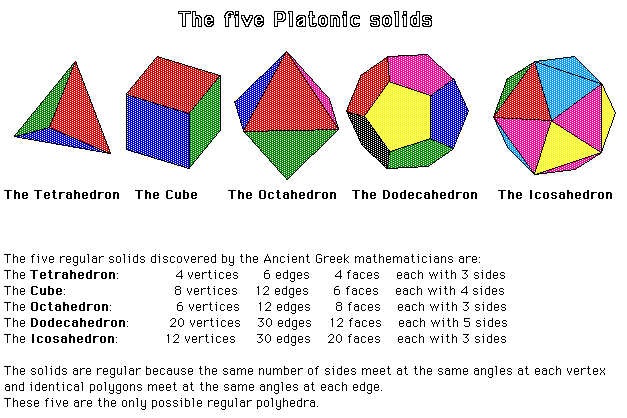
Searching the web, I recently found a site with at least a hundred names and styles of new diamond design, but as with the Platonic solids there are really only a few basic shapes to begin with and everything else is pretty much derivative.
Until you start Dreaming…
Everyone knows that a diamond is forever. Ever wonder why?
In 1947, Frances Gerety wrapped up her work late one night, said her prayers and promptly had an epiphany. As a young copywriter for NW Ayer, the advertising agency of DeBeers, she deserves credit for having penned the famous line “a diamond is forever”. Those four words are now regarded as one of the greatest marketing slogans of the 20th century.
With a single stroke of genius Frances set the emotional hook for everyone to both cherish and hold onto their diamonds – simultaneously boosting demand, stifling a secondary market and adding tremendous extra value to these shiny baubles.
It’s not like she had nothing to work with. No matter how or whether they’re marketed at all, diamonds have intrinsic appeal. They are unmatched in many respects, if not magical. Their very origin is dramatic, their history mysterious and their physical properties superlative. They are elemental and pure. Ever since they were first discovered, diamonds have been awe-inspiring to nobles and the hoi-polloi alike. And, they are perfectly marvelous eye candy.
I’ll bet you didn’t know that diamonds haven’t always looked so good.
Stay tuned. In my next post, I’ll discuss innovations and trends in cutting styles.
Your girlfriend and all her friends… and her family… and her coworkers expect you to give her a nice bright, colorful and shiny rock when you finally decide to propose. Tradition says that a diamond works best.
Alas, there are always those who choose to rain on everyone else’s parade. Unless you are oblivious to the media, I’m sure you’ve heard a thing or two recently that makes you ponder a darker side of diamonds.
Diamonds are born deep within our earth. They erupt to the surface through violent volcanic explosions that seem to occur in the starkest wastelands and loneliest geographic locations known to mankind. Even then, tons of earth must be dug up, exposed and sifted before even the tiniest pebbles begin to emerge.
Let’s face it, mining of any minerals is rarely considered to be a pretty business. Historically, mining has been relegated to slaves, convicts, servants, immigrants and other less fortunate souls. Come to think of it, the only really joyful diamond miners that quickly come to my mind are the Seven Dwarfs, but their mine was in Disneyland and they had Snow White back home.
OK, but let’s not delude ourselves with fairy tales. The story of diamond mining is complex. To begin with there are two distinct methods - underground mining and alluvial mining.
Surprisingly, underground diamond mines are among the most technically advanced mines in the world. By global standards, the safety records of the world’s deepest diamond mines, at over a mile beneath the surface, are exceptional. In addition, the miners – who most probably will never see an actual diamond crystal in their entire career underground – are very often among the best paid workers in their communities.
Alluvial mining is another story. This work is mostly done by individual diggers in dirt poor countries simply using a shovel and pan. It is back-breaking work undertaken in harsh climates. But in many places – especially African countries with notoriously depleted tropical soils and bleak agricultural prospects – it is the most accessible if not the only means of earning any cash income.
Given their unique value, the wealth from diamonds can ultimately be used for cross purposes. Particularly in Africa, diamonds have been used alternately to divide and oppress people as well as to aid them in their fights for freedom and attempts to build democracy.
Perhaps the worst case scenarios were the pro-longed civil wars in West Africa during the 1990’s. On the other hand, the best case scenario is modern Botswana, whose diamond bonanza over the past 40 years has led to exemplary economic development which today includes approximately 15% ownership stake in DeBeers itself!
After exposing abuses in apparel-making sweatshops and pesticide-riddled fields throughout the world, human rights advocates have rightfully focused attention on the diamond trade. The response from the diamond industry has been top notch.
The good news is that the diamond producing countries, major diamond manufacturers and the NGO's have all come together to craft the Kimberley Process. This historic agreement promotes and ensures best-practice policies in the global diamond business. It collectively monitors working conditions as well as the flow of diamonds worldwide.
So, diamonds are still the ultimate symbol of love. They are still nature's miracle. They are one of the most common elements of life – carbon – in its rarest, densest and purest crystallized form. Millions of years old, formed under extremely intense heat and pressure, the hardest substance know to man – diamonds are enduring and timeless. Even in raw form they are beautiful to behold, but when they are cut as gems to their best advantage they are spectacular and dynamic works of art.
If you wish to express your love with a diamond, you are definitely on the right track as far as I’m concerned.
Today the best diamonds are cut precisely for beauty, by the most skilled artisans using state-of-the-art techniques. They come from high quality rough crystals, supplied through non-conflict sources. They are independently graded for color, clarity, weight and above all exemplary light performance. They bear inscriptions attesting to their authenticity and provenance. They are sold at only the finest jewelers. They remain the crème-de-la-crème of all gemstones.
Trust me, the symbolism and beauty of a diamond still has the power to warm your girlfriend’s heart.
|
 News flash! Lots of people are buying and selling gold these days. The reasons seem simple enough.